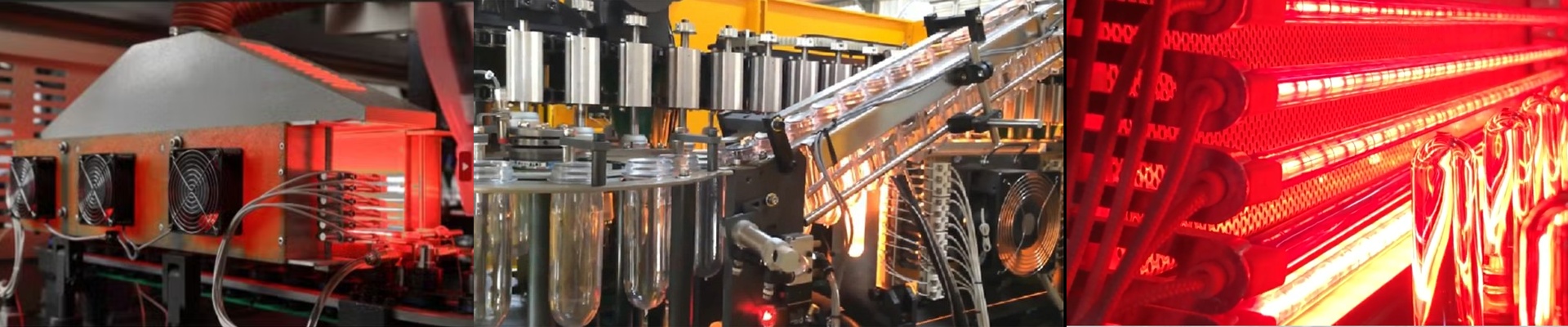
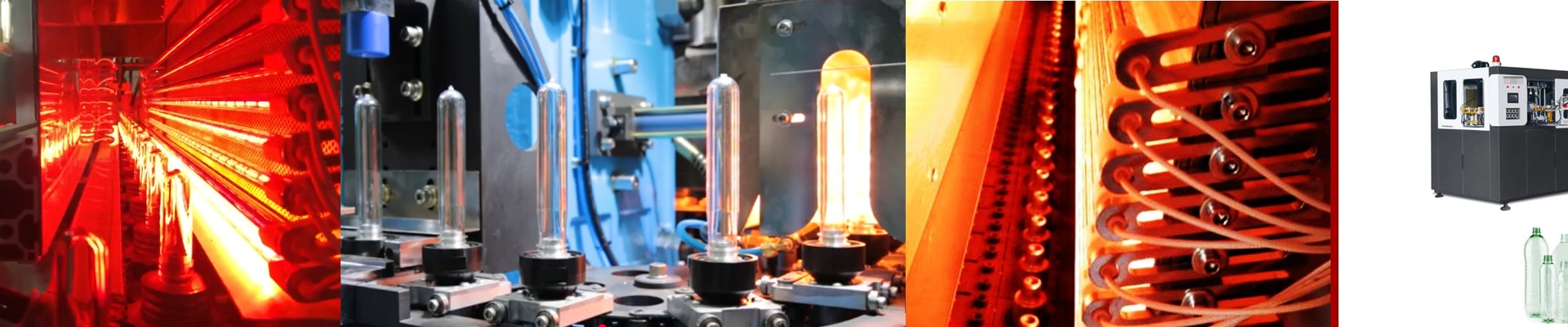
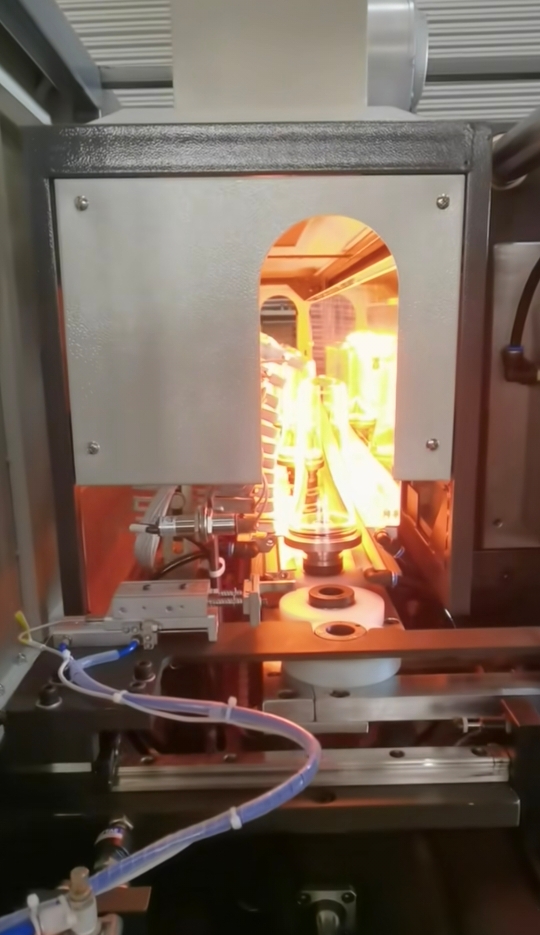
On the blow molding floor, the heating tunnel quietly sets your shift’s fate—scrap rate, schedule, and energy spend. When the preform reheat profile slips—shoulder running cold, neck too hot—you end up with flash, crystallization, or a weak biaxial stretch. The machine still turns, but yield falls and your operators spend the shift patching temperature instead of running it. We build preform reheat oven systems around one idea: the emitter has to match the blow molder’s original heating geometry and control behavior, so the oven acts the way the machine was intended to run. On Sidel, Krones, SIPA, Husky, SACMI, and Nissei ASB lines, that means true 1:1 parameter alignment—wattage, voltage, length, spacing, and connector type—so you can replace without rewriting the heating strategy.
What matters, technically
If you want repeatable wall temperature on preforms, you control three things: spectral output, energy density across the preform, and how fast the system responds thermally. Short-wave infrared halogen emitters make sense here—they heat fast, cool fast, and give you tight control in a tight heating tunnel. The numbers aren’t marketing. They’re what the machine is expecting.
- Emitter Power & Voltage: We match OEM tunnel configurations with standard ratings—commonly 1000 W and 1500 W per emitter, aligned to 100–240 V supply per zone. That keeps power density where the original design put it, avoiding hot spots and underheated transitions.
- Spectral Output: Short-wave infrared, typically peaking around 0.9–1.2 µm, hits PET quickly for deep surface heating without overdriving the neck finish—important when cycle time is non-negotiable.
- Physical Match: Emitter lengths are built to match reflector spacing and the preform path. You’ll see typical lengths like 120 mm, 180 mm, 240 mm, and 320 mm, with custom lengths for non-standard tunnels.
- Connector Compatibility: We use genuine industry connectors—oftenR7sfor halogen/IR lamps—so it plugs straight into the existing lamp holders and wiring harnesses.
- Temperature Control: The system supports closed-loop zone control with thermocouple feedback (commonly K-type), matching OEM control logic so SCR or PID tuning stays stable. When we say 1:1 parameter matching, we mean the emitter behaves electrically and thermally like the original—so the blow molder’s recipe settings stay valid without retuning.
Why this approach holds up in the real world
If you run a Sidel, Krones, SIPA, Husky, SACMI, or Nissei ASB blow molder, you don’t need a new oven concept. You need a replacement that keeps the machine’s heating behavior intact.
- Compatibility without rework: Emitter dimensions, mounting, and connectors line up with OEM lamp holders and reflector geometry. You swap lamps without changing brackets, rewiring the tunnel, or redesigning reflectors.
- Stable preform temperature profile: With matched power density and response time, the shoulder, body, and neck hit the blow station in the intended temperature window. That means consistent stretch, fewer pinholes, and less crystallization in the areas that always give you trouble.
- Uptime you can bank on: These emitters are built for continuous cycling. In practice, many installations run5,000+ hoursbefore output falls below usable levels, depending on line speed and tuning. Fewer lamp changes means fewer stops and fewer restart scrap sheets.
- Energy use you can account for: Short-wave IR heats the preform directly, with minimal wasted convection heat. When the emitter matches the original spec, you avoid the energy creep that comes from running a mismatched lamp and trying to compensate with higher current.
- Spares that make sense: A 1:1 replacement strategy keeps your spare inventory predictable. One lamp type can cover multiple machine platforms, cutting down on SKUs and simplifying purchasing. This matters most on high-output lines—where a 30-minute drift in heating can wipe out an hour of clean production.
The details that bite you if you ignore them
A direct-fit preform reheat oven upgrade is straightforward, but the plant floor still has its own rules.
- Check the control strategy first: If the machine is running a different control method than the OEM spec—aftermarket controllers, custom tuning, or altered zone logic—matching lamp parameters won’t fix everything. The emitter can be perfect, but the control loop has to be compatible.
- Reflectors set the performance floor: Even with the right lamps, pitted or oxidized reflectors cut effective energy delivery. If reflectors are worn, you may need a refresh to get the full benefit of matched emitters.
- The tunnel is a harsh environment: Heat cycling, vibration, and contamination are constant. Verify lamp alignment after maintenance, and make sure lamp holders are clean and not arcing. A misaligned emitter will wreck heating uniformity fast.
- “Equivalent” is not the same as identical: Wattage alone doesn’t cut it. If cold resistance and thermal response differ, zone control starts overshooting or undershooting. Match the full electrical and dimensional envelope, not just the label. If you want to replace a preform reheat oven system without re-commissioning the entire blow molder, start with the OEM-matched emitter spec. Match wattage, length, connector, and response. Then the heating tunnel does what it was designed to do—deliver repeatable preform temperature, shift after shift.